I wrote this a few years ago as a twitter thread after the start of the Russian war in Ukraine. I left twitter a few years ago, so I am reposting it here, as all of this is still valid in relation to green growth, economic sanctions and the Global South. If anything it is even more current as Europe is turning a blind eye to Trump’s politics just as they did with Putin and Netanyahu and forgetting about climate change while trying to please the rich and powerful.
——————————————————————
Recent events in global politics, Russia’s attack in Ukraine and the ensuing economic sanctions have led to calls to hasten our movement from fossil fuel dependency to green solutions. Green growth, however, is not the solution. Follows an explanation on why.
The fact that economic sanctions are used only in such an extreme case, not when human rights have been broken for decades, shows the link between economic growth and power. Growth and trade go before human rights and justice and political power is linked to economic power. Putin did not suddenly turn into a human-rights violating monster, he has been suppressing democracy at an increasing pace for 20 years in Russia, yet it is only now that our own security is threatened that sanctions are made in the name of democracy and human rights.
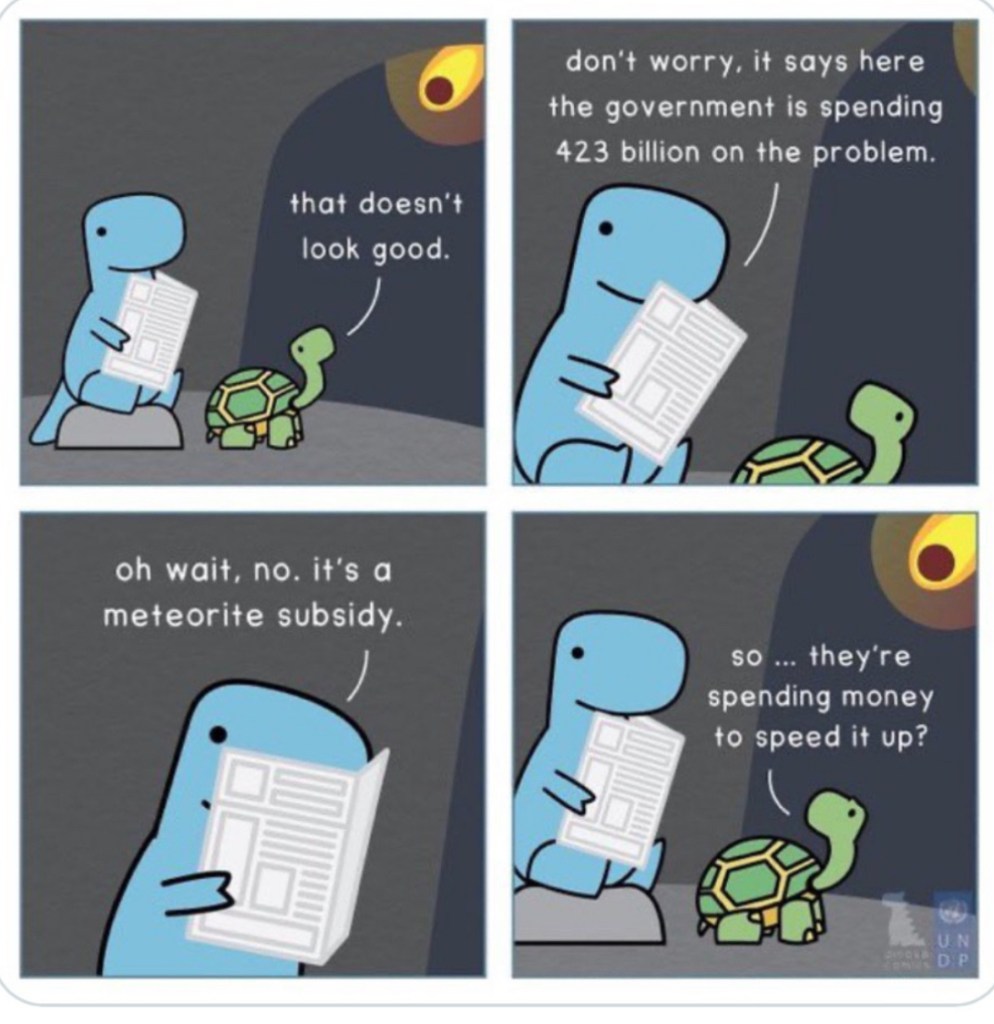
The same governments that are failing to stop fueling Putin’s war by still relying on his gas and oil are the ones that failed to come up with real solutions to climate change at the COP26, who spend money on subsidising fossil fuels, which does nothing to stop climate change. A point well illustrated by this comic referencing the movie Don’t look up.
Neoliberal economics corrode democracy because power is concentrated in the hands of those who own the most. At the root of the problem is our global system, in essence the capitalist growth paradigm which puts all else secondary to economic growth.
This same economic system and economic growth paradigm is at the root of the global climate crisis, through the overuse of natural resources. Climate change in its part is linked to issues of climate justice, where the consequences of it are felt most by those with least power. This is also illustrated by how powerful fossil fuel companies sat at the tables at COP26, while for example indigenous people, who are affected by the consequences of climate change, stood outside protesting with no real power or representation. Interestingly it seems that even green growth solutions can be harmful when economic growth & profit go before justice and decision making power isn’t equally distributed. An example of that is illustrated in this podcast by Exalt at my faculty and Alexander’s Dunlap .
As activists have called out what we need is system change. Green growth, scientists have shown, is not a possible or working solution to stop the effects of climate change. Continuing to prioritise economic growth also fails to address the issues related to power and justice. The contradictions between green growth and climate change mitigation have been described at length by (among others) Kallis and Hickel, for example in this open access article.
Instead of green growth and otherwise business as usual, degrowth offers an option arguing for a switch from ‘wealth’ to ‘well-being’, living simpler but more satisfying lives. Such a system change would also require looking at how power is distributed globally and locally.
Even the latest IPCC report cautiously suggests that we need to move towards understanding prosperity as equity in well-being, grounded in unanimity over shared goals and resources, and economic & social progress through stewardship and care (Chap 18, p.20). In its climate resilient development suggestions the IPCC report questions GDP growth as a measure of increased welfare pointing out how as a measure of market output it is an inadequate metric for gauging well-being (Chap 18, p.19). It continues: “Linking development to economic growth creates significant challenges for Climate Resilient Development, as it implies that the very processes that have contributed to current climate challenges, inc. economic growth, are also the pathways to improvements in human well-being”
The connection between economic growth and increased well-being is feeble at best. In Finland a calculation of the genuine progress indicator (GPI) showed that since the recession of the 1990s, after more neoliberal economics were introduced GDP growth hasn’t led to equally increased well-being. The following image shows how GDP growth in Finland has not been simultaneous with increased wellbeing, measured by GPI, specially since neoliberal economics in the 1990s. Why then do we keep insisting on GDP and economic growth?
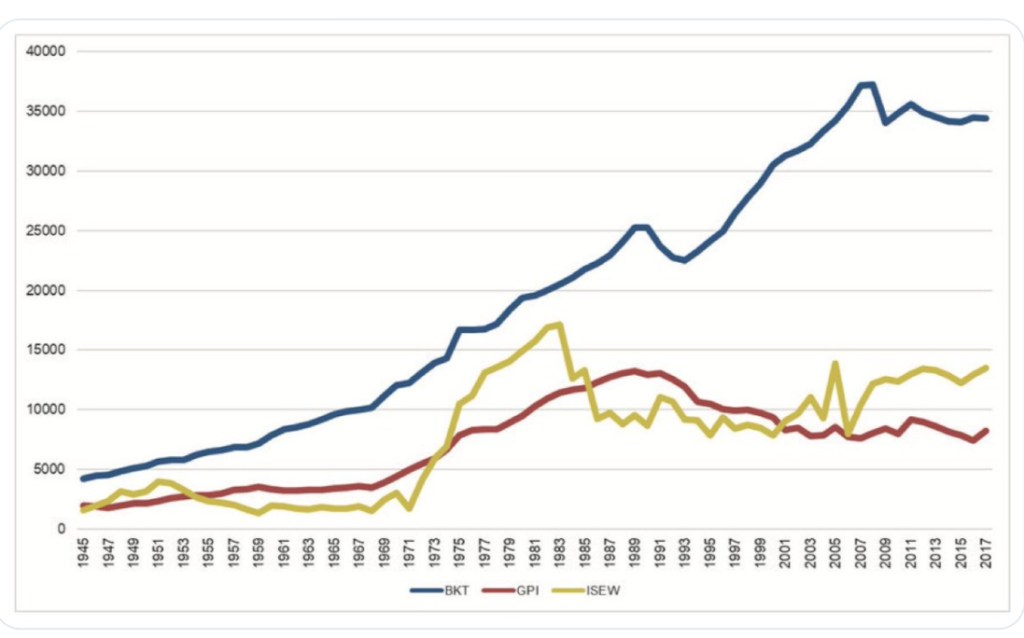
This is the case in Finland, the world’s happiest country, but could be proven anywhere. The more unrestricted neoliberal policies are, the more visible the inequality. Economic growth doesn’t lead to better well-being but it still continues to be pushed and unquestioned, despite there being plenty of evidence to show that to avoid ecological catastrophe without increasing inequality we must reduce and redistribute, adapt welfare systems for a future of slower, if not negative economic growth.
Instead of being the only or the best solution, economic growth, and thus also green growth as the solution to the climate crisis, is pushed because of power politics linked to the neoliberal economic model. At the same time other solutions are rejected.
One argument against degrowth as a solution for climate change is that it is unfair towards poorer countries. Growth-ideology is defended with the pretense that countries in the global south should be allowed to experience economic growth, a very faulty way of thinking. An old but gold take on why that line of thinking is not logical. The same neocolonial capitalist policies that have led to climate change are what has hurt the global south and in fact disabled growth and wellbeing.
The Global South is poor because of plunder by the growth-obsessed Global North. Dependency on foreign capital and neoliberal policies for access to global markets have in fact increased inequality and stifled growth in the Global South. Countries in the global south have been used by the global north (cheap labour & cheap nature), their people used and environment being destroyed through neocolonial practices of logging, mining, monocrop plantations etc.
Rejecting degrowth by claiming to think of poorer countries right to growth thus ignores the way growth in the Global North has been dependant on exploiting the Global South. It is not for the wellbeing of the poor that growth ideology continues being pushed.
Now if ever we should wake up to how global power linked to neoliberal growth ideology is at the root of many of the global issues we face, from fuelling authoritarian leaders and turning a bling eye to abuse, to causing increased inequality and of course climate change. In the words of degrowth proponent G. Kallis: ”Ecologising society is not about implementing an alternative, better, or greener development. It is about imagining and enacting alternative visions to modern growth-based development.”



 Everything is political
Jätä kommentti